
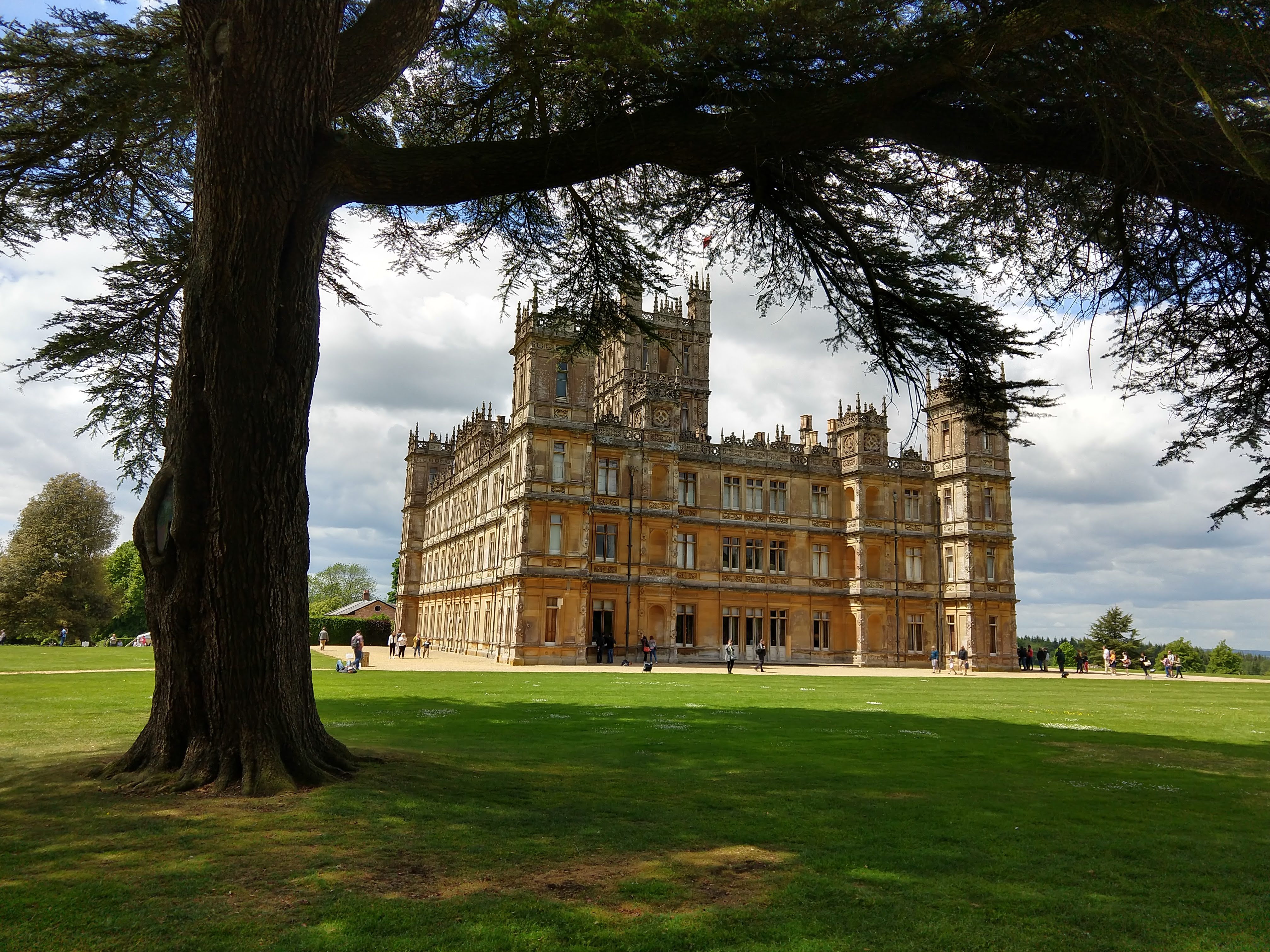
Several years ago, we took our son to England and the Netherlands for his 16th birthday. We had watched Downton Abbey as a family, so I desperately wanted to visit Highclere Castle, where the show was filmed.
There was just one problem: I couldn't get tickets. Everything I found online was sold out. But somewhere in all my research, I read that sometimes—sometimes—tickets were available at the gate. We decided it was worth a try. Even if we couldn't get in, we'd get to see the outside, which features pretty prominently in the opening credits anyway.
So after an overnight flight to London, we picked up our rental car and drove straight to Highclere. And it worked. We got in.
I remember touring the house and recognizing rooms from the show. I remember being amused to discover that yes, that's actually the furniture. They really did just come in and film a television show in somebody's house. But the part I remember most clearly is sitting outside behind the castle on a surprisingly lovely May day, having a cream tea. A scone with clotted cream and strawberry preserves, a cup of tea, and the three of us sitting in the sunshine in the English countryside after somehow pulling this thing off.
Years later, Ian rediscovered Downton Abbey as an adult. Now when he watches it, he gets to say, "I've been there." His significant other, completely independently, has been there too. Highclere comes up in conversation. We see it on television. And every once in a while, I get to revisit that afternoon in the sunshine.
Bill Perkins, in Die With Zero, calls these memory dividends. The idea is that an experience doesn't stop producing value when it's over. You enjoy it while it's happening, but then you get to remember it, talk about it, laugh about it, and connect things you're experiencing now with things you did years ago. A good experience can keep paying you back for the rest of your life.
I've been thinking about that idea a lot lately, particularly because it has changed the way I think about the trips worth taking in the first place.
The right trip isn't just about where you go
Another idea in Die With Zero is time bucketing. Instead of keeping one enormous bucket list of things you'd like to do "someday," you think about which experiences belong in different periods of your life.
Some trips really can wait. Others can't. There are experiences that are perfect when your children are little, trips that require physical abilities you may not always have, and places that become meaningful because of an interest you have right now. There are also trips with parents, children, siblings or friends that belong to a particular season when those people can travel with you.
I've come to think about trip planning as finding the right traveler, the right place and the right moment in life.
I once planned a Mexican Riviera cruise for two couples. The women are sisters of Mexican descent, several generations into their family's life in the United States, and they wanted the opportunity to experience more of Mexico and connect with that part of their heritage.
They visited places where they learned about Mexican tile making and tequila production. They learned more about the culture, and they bought an astonishing amount of stuff to bring home. They loved it.
Would that have been enough cultural immersion in Mexico for Spanish-speaking me? Nope. But it wasn't my trip.
These travelers are older, and independently navigating unfamiliar places would have made the experience harder rather than richer. Being able to get on a bus, know that the transportation was taken care of, and still encounter pieces of Mexican history, craft and culture gave them exactly the experience they wanted. It was the right trip for them.
That's an important distinction, because travel doesn't become more meaningful just because it's farther away, more adventurous, more expensive or more culturally impressive. A week at a theme park can become part of your family's story just as surely as a month exploring another country. What matters is whether the experience fits the people having it, at the point in their lives when they're having it.
The plan isn't the point
Long before I became a travel advisor, I was apparently willing to do the job for free.
My husband's extended family once took an enormous trip together: parents, siblings, spouses and seven kids, for a grand total of 15 people. We went to Walt Disney World, Universal Orlando and the beach, and I planned the whole thing from beginning to end. Where we were going, when we were going, dining reservations, park plans, Disney's various Byzantine systems, where everyone needed to be and when they needed to be there. All of it.
At some point during the trip, my sister-in-law said something to me that has stuck with me ever since. We had watched a parade at the Magic Kingdom, and she told me how wonderful it had been to watch her little girls' faces as they watched it—to see the wonder in their eyes and simply enjoy that moment with them.
She didn't have to figure out where they should stand, check an app, think about what they were doing next or worry about where 15 people were eating dinner. She got to watch her daughters watch the parade.
I think that may have been one of the first times I understood what good travel planning actually does. The point of the plan isn't the plan. The point is what the plan makes possible.
There are plenty of people who love researching their own trips. I'm obviously one of them. I will happily read everything I can get my hands on, watch an embarrassing number of YouTube videos, compare transportation options, learn unnecessarily complicated ticketing systems and develop opinions about which neighborhood makes the most sense for people who aren't even leaving for six months.
But somebody has to do that work, and too often that same person remains responsible for the trip once everyone arrives. They're standing somewhere they've dreamed of visiting while checking the train schedule. They're sitting at dinner while figuring out tomorrow. Part of their brain is always keeping track of what happens next and whether everyone else is having a good time.
They're on vacation, but they're also the tour guide.
For me, preparation isn't the opposite of spontaneity. It's what makes spontaneity possible. Do the thinking before you leave. Make the decisions that actually need to be made. Understand how things work. Know where you're going and which parts of the trip genuinely don't need a plan. Then, when you're there, you have enough space in your brain to actually experience it.
A collection worth keeping
All of this has been on my mind as my travel business has evolved.
When I started Enchantment for Everyone Travel, I couldn't have articulated any of this particularly well. I knew I loved travel. I knew I loved planning it. And I discovered pretty quickly that I loved helping other people experience it.
Over time, though, I've gotten much clearer about what I actually want this business to do. I don't want to collect destinations for my clients or help them work their way through some generic list of places everyone is supposed to see. I want to help people choose experiences that make sense for who they are and where they are in their lives, and then prepare them well enough that they can actually be present for those experiences.
And I want them to come home with things they can keep—not necessarily things, though my Mexican Riviera clients would apparently like a word.
I mean the sunny afternoon behind an English castle. A connection to the country your family came from. The look on your daughter's face while she's watching a parade. A meal you'll talk about for years, a ridiculous family joke, a place you didn't expect to love, or a moment that seemed fairly ordinary at the time and somehow became the thing you remember most.
Traditionally, a curio is an interesting or unusual object worth keeping. A curio cabinet becomes a collection gathered over a lifetime, filled with things whose real value often isn't the object itself but the story attached to it.
I've realized that's a pretty good description of the kind of travel business I want to build, except the collection I'm most interested in isn't something you can put on a shelf.
It's a lifetime of experiences worth remembering.
And that's why Enchantment for Everyone Travel is becoming Curio.
Travel deeply.